
Colorado County Same-Day Release Route
The official Colorado County Sheriff Jail Division page is a contact page. It has no public roster, name field, booking rows, release archive, or filter for the prior day. The official navigation reviewed in August 2026 also revealed no vendor feed. That absence is important. A page labeled as a live Colorado County 24-hour list would be invented, and a person disappearing from a page would still not prove community release.
Use the Jail Division as the first source. Ask whether the person remains at the Colorado County Detention Facility and, if not, request the public book-out time and the release or transfer category. Write down when the call occurred and the exact language used. An oral answer is useful for a quick check, but the jail-management release event is the stronger record.
Check Colorado County 24-Hour Releases
A bounded request avoids the vague phrase “recent releases.” It tells the Sheriff which existing report or release events to locate and makes the period reproducible. Use local time and state both endpoints. If the goal is one named person, the broader Colorado County release search and records guide explains how to pair the jail event with the relevant court case.
- Set the exact start and end timestamp for the prior 24 hours, including the time zone.
- Call the Jail Division at 979-732-2388 extension 2 and ask whether an existing book-out report covers that interval.
- Use the Sheriff’s official county page and Open Records Request Procedures for a written Texas Public Information Act request.
- Ask for existing release events keyed to book-out time, with the fields listed below and lawful redactions accepted.
- Read each release type before deciding which receiving system to check.
A request should seek records already kept by the agency. It need not demand a new analysis. Ask which existing report is generated by release timestamp if the named report differs from “release report.”
Colorado County Release Fields
No online Colorado County feed publishes a field set. These are request fields documented in the research, not promises about what a webpage shows. Supply a full name, birth date if known, booking number if known, and approximate arrest or release date so staff can identify the correct event.
| Requested field | What it can establish |
|---|---|
| Book-in and book-out date/time | The recorded span of Colorado County custody and whether the event falls inside the chosen day. |
| Booking number | The jail event tied to the correct person and arrest. |
| Release type or authority | Whether the departure followed bond, a court order, time served, sentence completion, or another basis. |
| Transfer destination | The receiving agency when that information is public. |
| Charges at release | The booked matters associated with the event, not proof of guilt. |
| Bond disposition | The bond event recorded when release was bond-based. |
Juvenile law, an expunction, a court order, protected identifiers, victim information, active investigative material, or security concerns can require withholding or redaction. A narrow request is more useful than assuming every field must be disclosed.
Colorado County Release Destinations
A 24-hour report counts departures from county custody. It should not label every row as a person who returned home. A surety or personal bond, dismissal, time-served judgment, completed county sentence, or other release order can lead to the community. A felony commitment may send the person to the Texas Department of Criminal Justice. Another warrant may send the person to another sheriff.
Federal paths differ. A federal writ or detainer may lead to the United States Marshals Service, while an immigration detainer may lead to ICE. Search the TDCJ inmate search only when the jail identifies state custody. That screen lists people currently incarcerated in TDCJ, so a match means continued state confinement rather than release from all custody. Use BOP, USMS or federal court, and ICE ODLS for their respective systems.
Note: Released from Colorado County custody is the safe description until the receiving authority or community release is confirmed.
Colorado County App Release Limits
The official Colorado County Sheriff TX app is a real county communication channel produced by OCV. Its public store text describes news, tips, reports, and interactive features. It does not promise an inmate lookup, released-person list, booking photograph, retention period, or 24-hour window.
The official Sheriff app listing can be checked for its current menu, but only an observed module should be treated as evidence. Record the module name, visible timestamps, status terms, and capture date if a jail feature appears. Do not infer that the app has a release feed merely because the Sheriff promotes it.
The official Sheriff website shows why this distinction matters:
View the Sheriff navigation and app link at the official source.
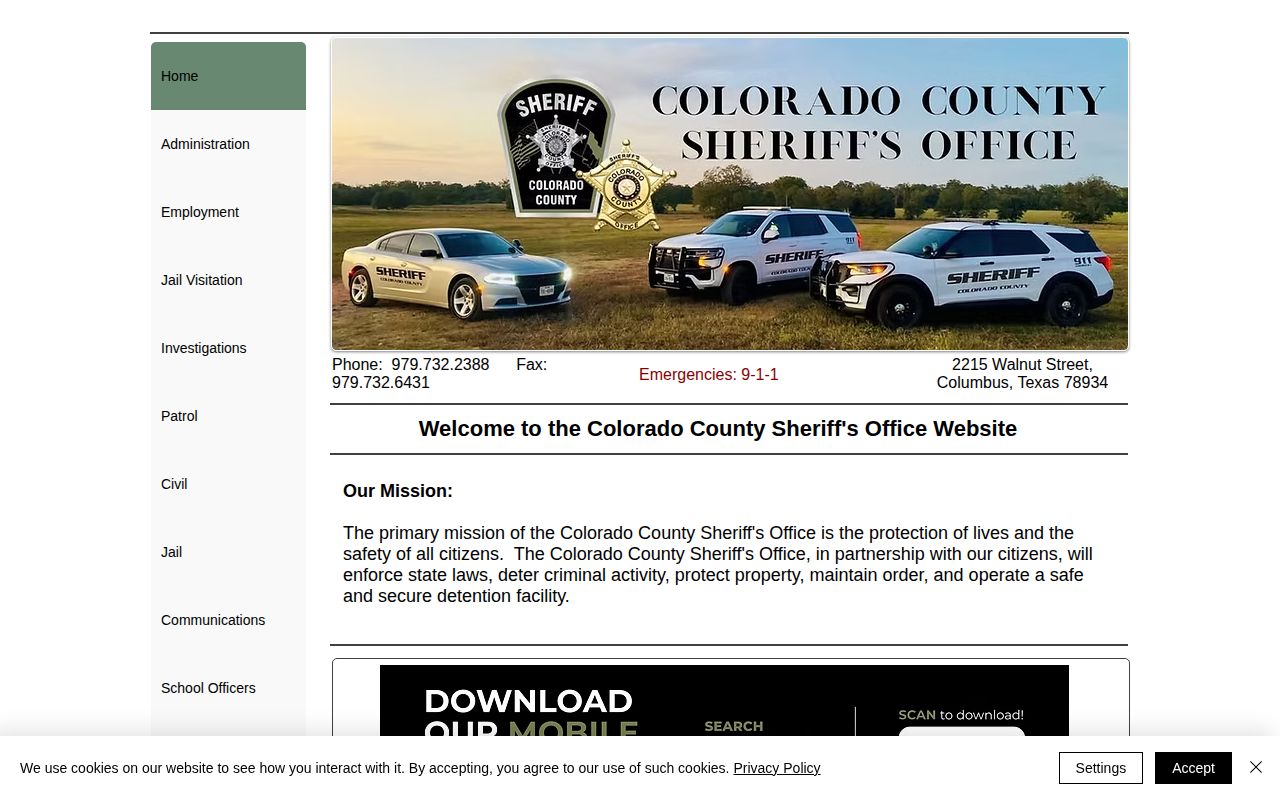
The captured page documents an official communication route, while the Jail Division source remains the place to ask about a release event.
Colorado County Release News Context
The Sheriff’s home page links The Banner Press, Colorado County Citizen, and Weimar Mercury. Those local outlets can preserve dated reporting about a notable arrest, court event, or public-safety incident when the jail page has no archive. News is secondary evidence. It is neither a complete list of releases nor the keeper of the book-out timestamp.
Use a report as a lead, then check the Sheriff and the correct clerk. County-level criminal matters may appear through the Colorado County Clerk’s criminal-record portal. Felony district matters are maintained by the District Clerk. A judgment, dismissal, bond order, sentence, or jail-credit entry may explain why custody ended, though it may not show when the door opened.
Colorado County Court Release Check
The court trail helps interpret a same-day jail event. Colorado County divides criminal records among several offices, so one search may not cover the filed matter. The County Clerk links a Tyler Odyssey portal for county-level criminal cases. The District Clerk keeps felony district records and provides public search terminals. Justice courts handle their limited criminal docket and preliminary matters. Match the clerk to the cause rather than assuming every booking resulted in a district case.
Search by full name and a narrow date range. Confirm the cause number, court, charge, filing date, and identifiers before relying on a result. Then read the docket for a bond order, dismissal, judgment, sentence, jail credit, commitment, probation order, or revocation. A signed court order can explain the legal basis for release, but it is not a substitute for the Sheriff’s exact book-out timestamp.
Timing also matters. A court may sign an order before jail staff complete identity checks, property return, paperwork, and other release processing. A docket event entered after the fact may look later than the physical departure. Preserve both dates and describe what each source proves. When the court record and oral jail answer seem inconsistent, request the existing jail release event and the signed order rather than choosing one source by guesswork.
Reading Colorado County Release Terms
Release labels have narrow meanings. “Released on bond” means pretrial custody ended under bond terms; it does not mean the charge was dismissed. “Time served” generally means the sentence or credited confinement was satisfied, but the judgment controls. “Transferred” means Colorado County custody ended while another authority may still hold the person.
For state cases, parole is conditional community release from a prison sentence. Discharge generally means the sentence has ended. Neither term should be assigned to a county event unless the source record uses it. A death also ends jail custody but must never be grouped with ordinary community releases. Clear labels protect the accuracy of a 24-hour report and tell the reader which agency to contact next.
Released Versus Colorado County Custody
Colorado County has no public live roster on the reviewed website, so roster presence cannot be used as the local test. Call the jail for current facility status. Then request the written release event if the distinction matters. If the only answer is “not here,” ask whether staff can state the book-out time, event type, and receiving authority.
Texas VINE can add a fast notification layer when the participating agency supplies the record. Search the person, confirm the agency and identifiers, and preserve the precise status and status date. “Released,” “out of custody,” and “transferred” are not synonyms. VINE republishes agency data and can lag, so confirm any alert with the Sheriff. The statewide system is also not a federal locator.
The wider Colorado County 72-Hour Release List guide is more useful when a same-day boundary misses an event near midnight or across a weekend. In either window, the source timestamp and time zone belong beside the result.