
TDCJ Release Outcomes
The Texas Department of Criminal Justice Correctional Institutions Division operates or contracts for prisons and state jails across Texas. A Colorado County felony prisoner can be assigned anywhere in that system. County of conviction, prison unit, release unit, approved residence, and parole office are separate facts.
A person may transfer within TDCJ, receive parole or mandatory supervision, reach sentence discharge, or enter another authority’s custody. Transfer stays within custody. Parole and mandatory supervision are conditional community release. Discharge generally means the state sentence ended. Quote TDCJ’s exact status.
Search Current TDCJ Custody
The official TDCJ Online Inmate Search says its results include only people currently incarcerated in a TDCJ facility. A match confirms current state custody. No match does not prove release.
- Use a seven-digit TDCJ number or SID number when available.
- Otherwise enter the exact last name and at least a first initial.
- Use gender and race only to narrow similar names.
- Open the matching detail and read every date by its label.
- Use email, telephone, or formal records channels for a former prisoner or unclear result.
| Displayed item | Meaning |
|---|---|
| Current unit | Present TDCJ placement, not county custody. |
| Projected release date | A Classification and Records projection subject to law and change. |
| Parole eligibility date | The point consideration may begin, not promised release. |
| Maximum expiration | The sentence endpoint calculation under the applicable record. |
| Scheduled release date | A later operational date that can still change. |
TDCJ Historical Release Requests
Former prisoners drop from the public live search. TDCJ’s no-charge email route can provide enumerated information including location, offense, prior incarceration history, current offense and court, and projected date. Send the full name and seven-digit TDCJ number to pia@tdcj.texas.gov. Without the number, provide exact birth date or approximate age and county of conviction.
Ask specifically for incarceration history and the actual release or discharge date and manner. If routine staff cannot provide the needed record, use TDCJ’s formal Public Information Act procedure. Include the custody period and exact fields sought.
Texas Department of Criminal Justice
P.O. Box 99
Huntsville, TX 77342-0099
936-295-6371
Official gateway: tdcj.texas.gov/ks_offender.html
TDCJ Telephone Release Checks
TDCJ lists inmate location and information at 936-295-6371 or 800-535-0283. An exact birth date is required when TDCJ or SID number is unknown. The official telephone page states hours of 8 a.m. to 5 p.m., Monday through Friday.
Different numbers serve different stages. BPP pre-vote review status is listed at 844-512-0461. Parole Division post-vote release status is listed at 512-406-5202. A favorable Board vote is not the same as physical release because certificate processing, a release plan, conditions, or required programming may remain.
TDCJ Projected Date Limits
TDCJ defines projected release date as a Classification and Records projection for release from incarceration if parole does not occur sooner, affected by offense title and date. It is not proof that release happened. Scheduled release is closer to an operational plan after certificate processing, but TDCJ warns dates may change.
Texas has no universal rule that all prisoners serve 85 percent. Government Code Chapter 498 governs good-conduct time, while Chapter 508 contains offense-specific parole and mandatory-supervision rules. Serious-offense provisions differ from the general eligibility calculation. Eligibility only opens consideration; the Board retains discretion.
Dates can change because credits are earned or lost, a sentence or jail credit is corrected, consecutive cases are added, a detainer changes destination, the Board acts, or release prerequisites remain. TDCJ Classification and Records is the authoritative calculator.
TDCJ Parole After Colorado County
The Texas Board of Pardons and Paroles makes parole and discretionary mandatory-supervision decisions. TDCJ Parole Division supervises releasees. The approved residence, not simply Colorado County conviction, controls district assignment.
TDCJ’s directory maps Colorado County to the Rosenberg District Parole Office in Region III, subject to the person’s assignment and directory changes. A person can leave prison for a halfway house or other structured placement and still face substantial restrictions. Full discharge is different from parole supervision.
- Parole
- Conditional release from prison after a discretionary decision.
- Mandatory supervision
- A statutory release framework whose eligibility and review depend on offense law and date.
- Releasee
- TDCJ’s term for a person under Parole Division supervision.
- Discharge
- The end of the sentence under the state record.
TDCJ Records and Parole Sources
The successful manifest capture shows the official TDCJ Parole Division source.
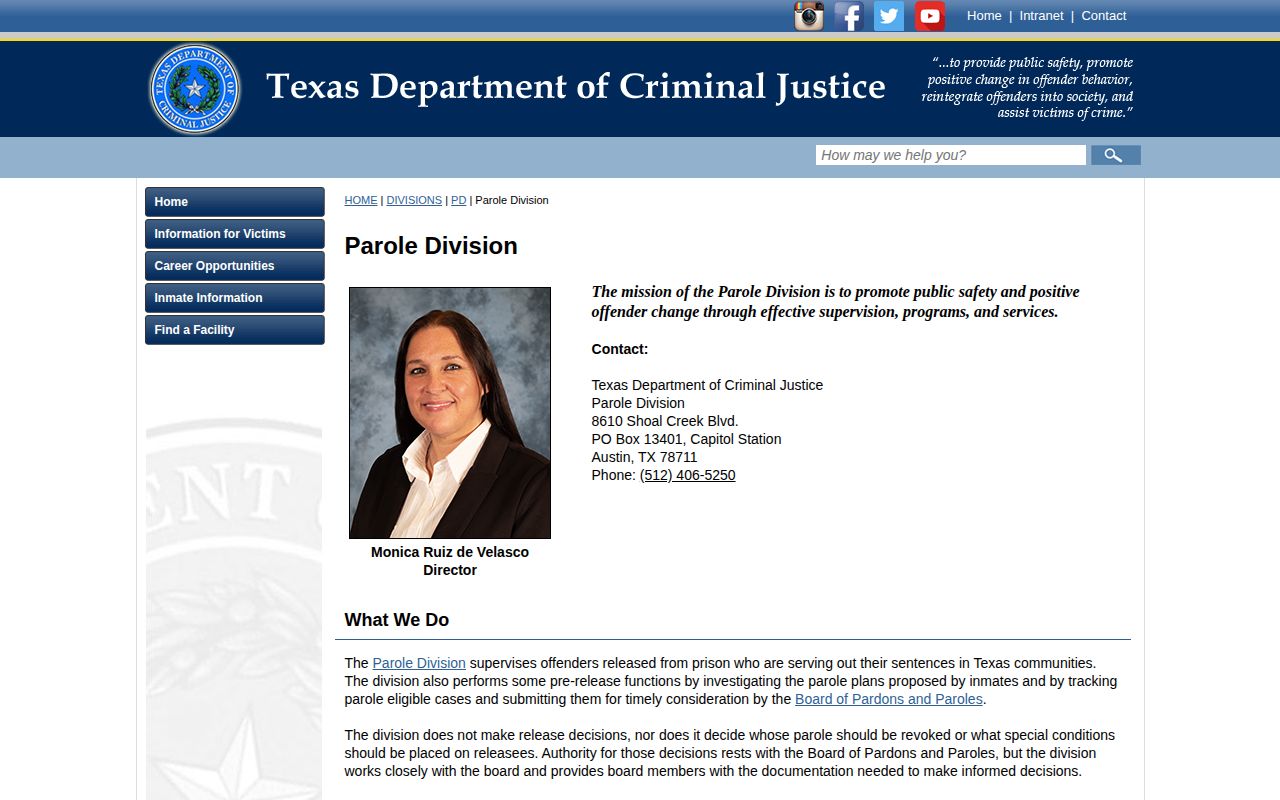
The division page concerns state supervision after prison. It is not Colorado County probation and not a former-prisoner locator.
The TDCJ inmate-information gateway links online, email, telephone, definitions, absconder, Board, and unit-directory channels. Use the channel that matches current custody, historical release, parole review, or supervision.
Colorado County and TDCJ Records
A Colorado County court judgment can show conviction, sentence, and jail credit. The Sheriff release ledger can show transfer to TDCJ. Neither alone proves the later state release. Match the cause number, TDCJ identifier, county of conviction, and custody dates.
When TDCJ releases or discharges the person, use TDCJ history and any Parole Division record. When a person only bonds out of the county jail, there may be no TDCJ record at all. The Colorado County released-inmate search routes local, state, court, and federal records by custody type.
No TDCJ Unit in Colorado County
The official unit directory review identified no TDCJ prison physically in Colorado County. This does not reduce TDCJ’s relevance to local felony cases. Prison placement and release can occur far outside the county.
A release unit may differ from the institution where most of the sentence was served. The approved residence may point to another county, and parole supervision follows that plan. Do not advertise the county detention facility as a TDCJ unit or use its local jail records as the state discharge record.
TDCJ Transfer and Detainer Checks
A TDCJ departure can lead to community supervision, full discharge, or another authority’s custody. A detainer can change the destination even when the state sentence reaches a release stage. Ask for the actual release manner and receiving authority where public.
BOP covers sentenced federal custody, USMS handles federal pretrial and transfers, and ICE handles civil immigration detention. Absence from one locator does not resolve the others. Preserve each system’s exact status and date.
TDCJ Mandatory Supervision Records
Mandatory supervision is not one fixed calculation for every case. TDCJ distinguishes offenses before September 1, 1996 from later offenses, and statutory exclusions also matter. For an eligible later offense, the Board performs discretionary mandatory-supervision review and can deny release under the governing criteria. A denial may move the projected date to maximum expiration.
Government Code sections 508.147 and 508.149 govern the framework and exclusions. The offense date and title must be checked before interpreting any projected field. Never calculate an individual date from a simple percentage. Use TDCJ Classification and Records.
TDCJ Good Conduct Records
Government Code Chapter 498 authorizes good-conduct classifications and credits. Credits can affect eligibility calculations, but they generally do not shorten the judicial sentence itself. Credits can be earned, forfeited, and in some circumstances restored under the state rules.
County-jail good time is separate. Colorado County publishes no local calculation policy on its Jail Division page. Do not import TDCJ rates into a county sentence. For a county term, request the Sheriff’s sentence-computation sheet and governing policy.
Correct a TDCJ Release Record
When TDCJ data and a court judgment conflict, identify the exact field, TDCJ number, cause number, sentence, and date range. The court corrects its judgment; TDCJ addresses its calculation or custody record. Keep the written response with the older result rather than silently choosing one.
A later status can reflect a genuine new event, not an error. Parole revocation, another sentence, a detainer, or return to custody can create a separate period. Preserve each event with its source date and exact label.
Public Record Search
Sponsored Results