
Colorado County Projected Versus Actual
A projected release date is an administrative forecast, not proof that someone left custody. TDCJ defines it as the Classification and Records Office’s projection for release from incarceration if parole does not occur sooner. Offense title, offense date, sentence structure, and the applicable release law affect the calculation. An actual release date records an event that already happened.
A parole eligibility date is only the point when consideration may begin. Maximum expiration generally reflects the sentence endpoint. A scheduled release date can appear after a release certificate is processed and is closer to an operating plan, yet TDCJ warns that dates can change. Keep each label attached to its value.
A pretrial Colorado County detainee has no fixed sentence-release date. Bond, dismissal, plea, trial, court order, or transfer controls what happens next. Ask about bond and court status rather than forcing a projected-date calculation onto an unsentenced case.
Find a Colorado County Release Date
Begin by identifying whether the person is in Colorado County Jail, TDCJ, another county, or federal or immigration custody. Someone transferred from the county jail to TDCJ has been released from county custody but remains incarcerated. Someone who bonded out locally may never appear in TDCJ.
- Ask the Colorado County Jail Division which agency currently holds the person.
- For TDCJ custody, search by TDCJ or SID number when possible.
- Otherwise use exact last name, at least a first initial, and offered sex or race filters.
- Open the matching detail and copy each date with its field label.
- When absent or unclear, use TDCJ email, telephone, or a formal records request.
The TDCJ online search expressly covers people currently incarcerated in a TDCJ facility. It is not a historical archive. A missing result does not prove release. The no-charge email information route can provide projected date and incarceration history when supplied with full name and the seven-digit TDCJ number, or exact birth date or approximate age and county of conviction when the number is unknown.
The official TDCJ definitions page explains the projected-release label shown in state records.
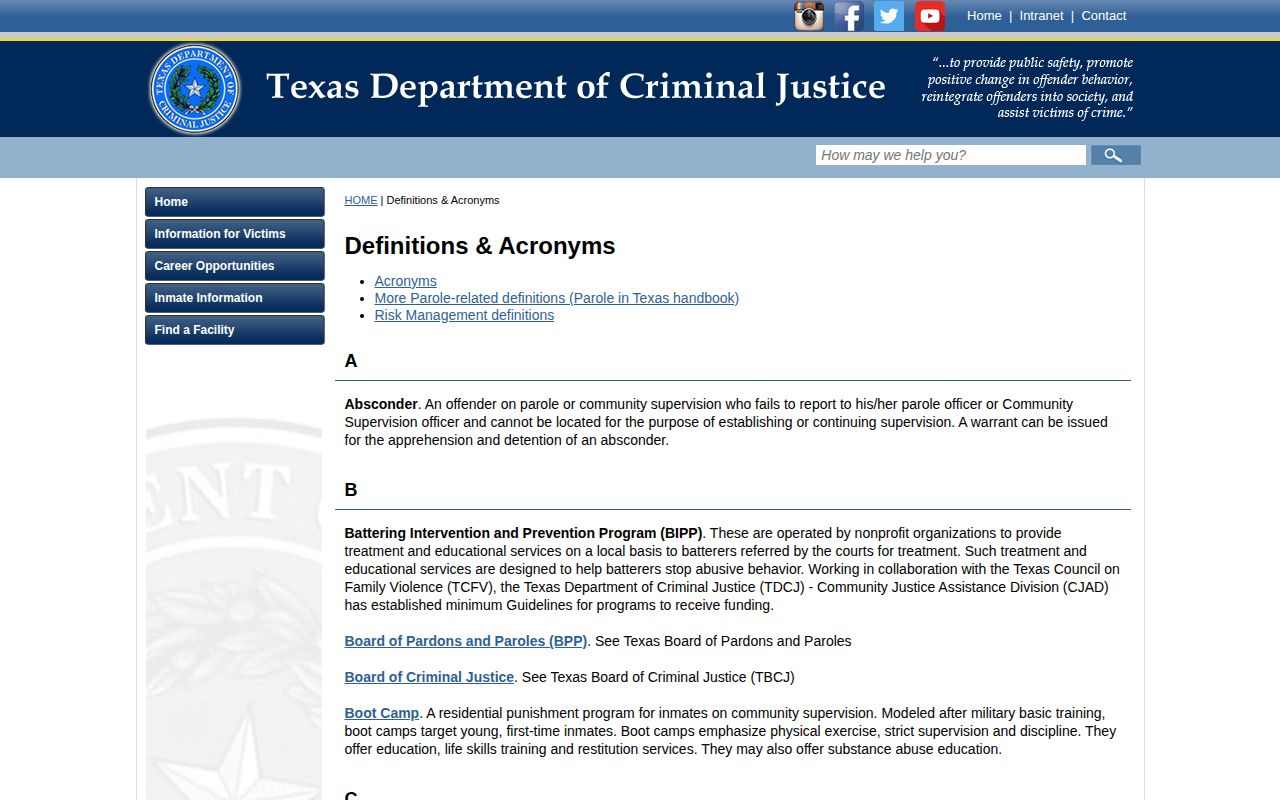
The captured definition helps distinguish the projection from proof of an actual release.
Texas Good Time Is Not 85 Percent
Texas has no universal rule that every prisoner serves 85 percent. Release eligibility depends on the offense, offense date, sentence, and statutory subsection. Under the general rule in Government Code Chapter 508, section 508.145(f) uses actual calendar time plus good-conduct time equaling one-fourth of the sentence or fifteen years, whichever is less, unless another rule applies. Eligibility allows consideration; it does not guarantee release.
Listed serious offenses and certain deadly-weapon findings follow section 508.145(d). That rule looks to actual calendar time without good-conduct time and uses one-half of the sentence or thirty years, whichever is less, with a statutory minimum. Other subsections cover other offense and sentence categories. A simple percentage cannot safely compute an individual date.
Government Code Chapter 498 authorizes TDCJ good-conduct classifications and credits. Credits may depend on conduct and diligent participation, and they can be forfeited or restored under the statute. Good time is not a vested right and generally affects eligibility calculations rather than shortening the sentence imposed by the judge.
Colorado County Mandatory Supervision Dates
Offense date matters for mandatory supervision. TDCJ explains that an eligible offense before September 1, 1996 may reach scheduled mandatory release when flat time plus good time equals the term, if parole has not occurred sooner. For an eligible offense on or after that date, the Board reviews discretionary mandatory supervision and may deny release under statutory criteria. A denial can move the projected date to maximum expiration.
Government Code sections 508.147 and 508.149 govern mandatory supervision and exclusions. Read the law tied to the offense date. A public field cannot reveal the whole calculation by itself, and the Board’s decision remains separate from the date at which review became possible.
- Flat time
- Actual calendar time served.
- Good time
- Administrative credit governed by TDCJ classification and conduct rules.
- Parole eligibility
- The point at which parole consideration may begin.
- Maximum expiration
- The sentence endpoint calculated under the controlling record.
Why Colorado County Dates Change
TDCJ Classification and Records is the authoritative calculator for state sentences. The calculation begins with sentence start and credit, identifies offense date and title, applies the controlling parole and mandatory-supervision rules, accounts for concurrent or consecutive terms, and incorporates administrative credits and Board action. Several later events can move the public date.
| Factor | Possible effect |
|---|---|
| Good-time earning or forfeiture | Changes an applicable eligibility or projected calculation. |
| Corrected jail credit or sentence | Changes the time credited or controlling term. |
| Concurrent or consecutive cases | Changes how multiple sentences interact. |
| Parole or mandatory-supervision vote | May permit, condition, delay, or deny release. |
| Program or certificate processing | Can delay a favorable decision’s scheduled implementation. |
| Detainer or hold | May change the destination even when one custody term ends. |
A favorable Board vote does not equal physical release. Conditions, required programming, release-plan approval, certificate processing, and detainers may remain. Date every saved result and recheck close to the event.
Colorado County Jail Good Time
County-jail sentences are not calculated with TDCJ’s state-prison chart. Texas Code of Criminal Procedure article 42.032 addresses county-jail good-conduct credit and sheriff administration. Colorado County’s official Jail Division page publishes no local good-time calculation or weekend-release policy. Importing a TDCJ rate would create an unsupported date.
Ask the Sheriff for the individual sentence-computation sheet and the governing local policy. The request should include full name, booking number if known, cause number, sentence date, jail-credit order, and the exact projected or scheduled date field sought. Also obtain the judgment from the correct Colorado County clerk because the jail applies the court’s sentence and credit.
The official Colorado County Jail Division page supports the local contact route but does not publish a calculator. That absence is the page’s distinctive release-date finding: the individual computation and policy are more reliable than a borrowed statewide formula.
Confirm Colorado County Release Timing
TDCJ lists inmate-information telephone service at 936-295-6371 or 800-535-0283 during its published weekday hours. It requires exact birth date when TDCJ or SID is unknown. Board pre-vote review status and post-vote release processing use specialized official telephone channels described on the TDCJ telephone information page.
For a county sentence, call the Jail Division and ask for the public projected or scheduled date, then request the existing computation record. For state custody, compare the current detail with TDCJ information staff. A formal TDCJ records request is the route for historical or nonroutine records.
Register a VINELink release notification as a change alert when the correct agency record participates, but confirm the event with the record custodian. VINE may lag, and a transfer alert is not return to the community. The Colorado County release search then connects the release event with the court disposition and any receiving agency.
After the predicted date, ask for the actual release or transfer time and legal manner. If another county, TDCJ, USMS, BOP, or ICE received the person, follow that system. “Released from Colorado County custody” should remain the description until downstream custody is checked.
Request Colorado County Date Records
A date inquiry should ask for existing records rather than a new calculation. For Colorado County Jail, identify the person, booking number if known, cause number, sentence date, and court. Request the sentence-computation sheet, jail-credit entries, projected or scheduled release field, governing Sheriff policy, and the actual release event after it occurs. The Sheriff’s public page does not state an online retention period or computation method.
For TDCJ, routine information is available online, by email, and by telephone. Ask for the projected release date with its label and as-of date, current location, offense and sentence identifiers, and incarceration history. When historical release or calculation records are needed, use the designated Public Information Act route. Supply the seven-digit TDCJ number whenever possible to avoid a same-name mismatch.
Court records remain essential. A corrected judgment, amended jail credit, concurrent or consecutive sentence order, revocation, or new commitment can change the inputs. County-level criminal matters are maintained by the Colorado County Clerk, while district felony matters belong to the District Clerk. The filed order controls over an informal estimate.
Follow Colorado County Release Destinations
A date predicts the end of one custody stage, not necessarily a return home. Another county warrant, federal writ, immigration detainer, or state commitment can move the person directly to another authority. Ask both whether the person left and where the person went. Describe the event as release from the named agency until the next status is checked.
For BOP custody, use the federal locator. For ICE detention, use ODLS. A federal pretrial detainee may remain with USMS or a contract jail before appearing in BOP. These databases do not share one universal projected-date field, and a county or TDCJ date should never be applied to federal or immigration custody.
After the event, obtain the actual release or transfer record. Compare it with the earlier projection and note any difference without guessing why. The agency may be able to identify a corrected sentence, changed credit, Board action, program requirement, or hold. Exact source labels and dated checks provide a sound record of what was known at each stage.
Colorado County Pretrial Release Timing
An unsentenced detainee does not have a TDCJ-style projected release date. The next event may depend on whether bond is set and posted, whether a judge changes conditions, whether the prosecutor dismisses a charge, whether a plea or trial produces a sentence, or whether another authority has a hold. The live court docket and Jail Division are the right sources.
Ask the clerk for the latest filed order and ask the jail whether a release order has been received and processed. Do not convert a hearing date, bond amount, or expected court ruling into a promised release time. Administrative steps and other holds may remain after court action.
Record Colorado County Date Labels
When saving a result, note the full name, identifier, custody system, field label, displayed date, and access date. Avoid copying a bare date into notes. Without its label, a parole eligibility date can later be mistaken for projected release or maximum expiration. Recheck the live source and keep later corrections with the earlier record.