
TDCJ Parole Release Destinations
The Parole Division is a supervision system, not a prison or release gate. A person enters it after TDCJ physically releases the person on parole or mandatory supervision. The approved residence shapes the assigned district office. County of conviction, prison unit, release unit, approved residence, and reporting office are different facts.
A person convicted in Colorado County can serve the sentence at a TDCJ unit elsewhere in Texas, leave from a different release unit, and report to an office outside the county. Someone convicted in another county can be assigned near Colorado County after an approved move. A halfway house or residential placement is release from prison under restrictions, not unrestricted residence.
The actual TDCJ release record establishes when prison custody ended and the legal manner. The Board vote and parole eligibility date describe earlier stages. Current office routing then helps identify supervision, but directory geography alone does not establish an individual’s status.
Confirm a Texas Parole Release
Begin with a TDCJ number or State Identification number. The TDCJ online inmate search covers people currently incarcerated in a TDCJ facility. Its projected and eligibility fields do not prove release, and a former prisoner may not appear because the live screen is not a historical archive.
- Match the person by TDCJ or SID number when possible.
- Check the current TDCJ record and copy every date with its label.
- Use Board inquiry for the vote status and exact decision code.
- After favorable processing, obtain the scheduled date and release unit.
- Confirm the actual release or discharge through TDCJ history.
- Ask the Parole Division for the current assigned office when publicly available.
The TDCJ inmate-information email route accepts full name plus the seven-digit number. Without it, provide exact birth date or approximate age and county of conviction. Ask for incarceration history, actual release or discharge date, and legal manner. Formal historical material uses the TDCJ Public Information Act process.
Colorado County Parole Office Route
TDCJ’s county-to-district-office directory maps Colorado County to Rosenberg. The current Region III page supplies the office contact. Check both before a visit because directory assignments and office details can change.
Rosenberg District Parole Office711 Highway 36 North
Rosenberg, TX 77471
281-232-0334
This is a navigation point, not proof that a named person reports there. Individual assignment depends on the approved address and later changes. Confirm the current office through official TDCJ information using the person’s state identifier.
The Rosenberg office should not be confused with the 2nd 25th Judicial District CSCD office in Columbus. That local department handles court-ordered probation. It does not supervise TDCJ parole or cast Board votes.
About TDCJ Parole Supervision
Texas separates release decisions from supervision. The Texas Board of Pardons and Paroles votes on parole and discretionary mandatory supervision. TDCJ Classification and Records calculates dates and processes release documents. The TDCJ Parole Division supervises people after release and administers conditions through district offices.
| Agency or record | Role |
|---|---|
| Board of Pardons and Paroles | Votes on parole and discretionary mandatory supervision. |
| TDCJ Classification and Records | Calculates and processes state release dates and certificates. |
| Parole Division | Supervises releasees and routes district-office reporting. |
| Colorado County courts and CSCD | Order and administer local probation, not state parole. |
A favorable vote can be followed by conditions, required programming, a release plan, detainer review, and administrative processing. Report the official vote code and wait for the actual release record before stating that the person left prison.
Read Texas Parole Vote Codes
The Board does not hold a routine formal person-by-person parole hearing. Its official panel-review explanation explains that members review and vote the file. A Board meeting agenda is not a calendar showing when every Colorado County prisoner will receive a release decision.
The vote-options list defines the result. FI-1 generally permits release when eligible, while other FI categories can point to a future month or required program. RMS concerns mandatory-supervision release. NR sets another review, SA requires service of the remaining term, and DMS denies mandatory supervision. Approval can be withdrawn when new information appears.
A vote code is not the door date. Obtain the processed scheduled date and release unit, then verify the actual event. If a detainer sends the person to another authority, describe release from TDCJ custody without assuming community arrival.
Verify Colorado County Supervision
Public confirmation should focus on the legal status and correct office, not protected reporting details. Ask whether the state record shows parole, mandatory supervision, discharge, or another status. Do not request or publish an individual schedule, private residence, treatment information, or protected case material.
- Parole
- Conditional release from a state prison sentence after Board approval.
- Mandatory supervision
- A statutory form of supervised state release governed by offense-date rules and, for many cases, Board review.
- Releasee
- TDCJ’s term for a person under Parole Division supervision.
- Discharge
- The sentence has ended under the controlling state record.
- Absconder
- A person is alleged to have stopped complying or reporting; the label does not prove present jail custody.
The specialized TDCJ sex-offender absconder search applies only to that defined population. It is not a directory of all people released on parole. Verify any warrant with the issuing authority.
Request TDCJ Parole Records
A narrow request should include full name, TDCJ number, date of birth if needed for matching, county of conviction, and the precise event. Useful records can include incarceration history, Board vote, actual release or discharge date, legal manner of release, and public office routing. Routine telephone and email information may answer current questions more quickly than a broad formal request.
TDCJ lists general inmate information at 936-295-6371 or 800-535-0283 during published weekday hours. Before a Board vote, its official telephone material lists 844-512-0461 for review status; after a favorable vote, 512-406-5202 addresses Parole Division release status. Recheck the official telephone page before calling.
The Colorado County released-inmate search path distinguishes a county-jail book-out from state-prison release. A person transferred from Colorado County Jail into TDCJ remains incarcerated. Parole supervision becomes relevant only after the later state release occurs.
Texas Approved Address Assignment
The official TDCJ Parole Division page identifies the statewide supervision system that receives approved release plans.
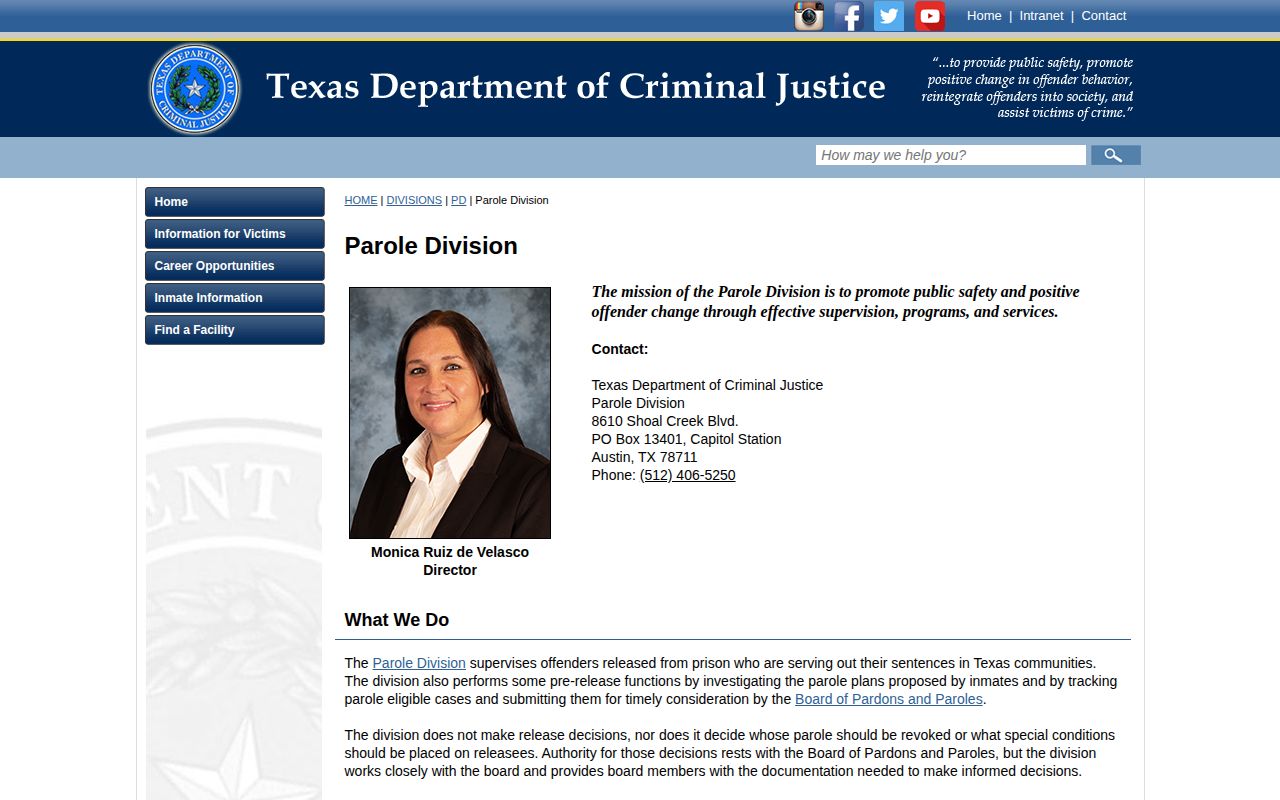
The state-level capture is a navigation reference; it does not identify any person’s assigned office or supervision status.
A proposed residence must move through the state release-planning process. Directory mapping does not mean every address will be approved or that the mapped office will remain the final assignment. Restrictions, required programming, residential placement, another jurisdiction, or a later approved move can change the reporting office.
For Colorado County, use Rosenberg as the official county-directory starting point and then confirm the individual assignment. Do not publish a private residence or infer it from a district office. A district can serve a broad area, and the office address is an administrative contact rather than the releasee’s home.
If a planned address changes before release, the scheduled date may also be affected while TDCJ resolves the plan. Ask release-status staff for the current processed information instead of treating an older plan as final.
Texas Parole Status Changes
Supervision can later involve a change of office, modified conditions, a warrant, alleged absconding, revocation proceedings, return to custody, or discharge. Each event has its own record. An allegation or absconder listing does not by itself prove that the person is currently confined. A jail, TDCJ, or other receiving agency must confirm custody.
When a releasee is arrested in Colorado County, search the new local case and request the jail custody event. Then check the state supervision record for any separate action. Do not merge the arrest, parole allegation, and final revocation decision into one event. The Board or other authorized process determines the supervision outcome.
At sentence discharge, preserve the effective date and source. Discharge differs from parole release because it marks the end of the sentence under the controlling state record. A person may also finish active supervision before some public web pages update, which makes dated TDCJ history more reliable than an undated directory result.
Colorado County to TDCJ
A transfer from the Colorado County Detention Facility to TDCJ is not parole. It ends county custody and begins or continues state imprisonment. Confirm the county book-out category, then search TDCJ for the receiving unit and current dates. Parole becomes a later possibility only when the governing sentence and Board process permit it.
The reverse path also needs care. A state prisoner may be moved temporarily on a bench warrant or writ without being paroled. The person can appear in a local facility while the state sentence remains active. Ask which authority retains legal custody and whether the movement is temporary.
These distinctions keep the facility map accurate: Colorado County Jail records the local departure, TDCJ records state confinement and release, and the Parole Division records post-release supervision.