
Colorado County Texas VINE Coverage
Texas VINE is reached through VINELink’s Texas landing page. It republishes custody information sent by participating agencies and can deliver notices about selected changes. It is not the keeper of the Colorado County booking ledger. The county sources reviewed do not guarantee that every jail event enters VINE, so confirm that a result actually names the Colorado County Sheriff or the agency currently holding the person.
VINE is designed around a specific person, not a countywide recent-release list. A result may report custody status, responsible agency, location, identifier, and status date. Fields vary. Preserve the exact label because “released,” “out of custody,” and “transferred” do not mean the same thing. A transfer ends one agency’s custody while another agency may immediately take control.
Texas state-prison notices also have a separate TDCJ channel. The Integrated Victim Services System can provide specified prison, parole, and discharge notices. It becomes the stronger notification route after a Colorado County detainee transfers into TDCJ.
Search a Colorado County VINE Record
Open the direct Texas person search. Full first and last name is the best starting point. The live interface supports name or ID searches. Research of the current controls found that Partial Name requires at least the first two characters of the last name, while a partial identifier requires at least four characters apart from leading zeroes.
- Select Texas and the custody or person search.
- Enter the complete name or the most reliable available identifier.
- Use the partial-name option only when spelling is uncertain.
- Compare every candidate’s agency, age or birth information, and identifier.
- Open the correct record and note the exact status, place, and update date.
Common names can return several people. Do not choose a result solely because the name resembles the person sought. Match the custody agency and identifiers. If no result appears, retry spelling and identifier formats, then contact the likely agency. Nonparticipation, removal, delay, or a name variance can all cause an empty result.
The official Texas search screen shows the state entry point used for this process.
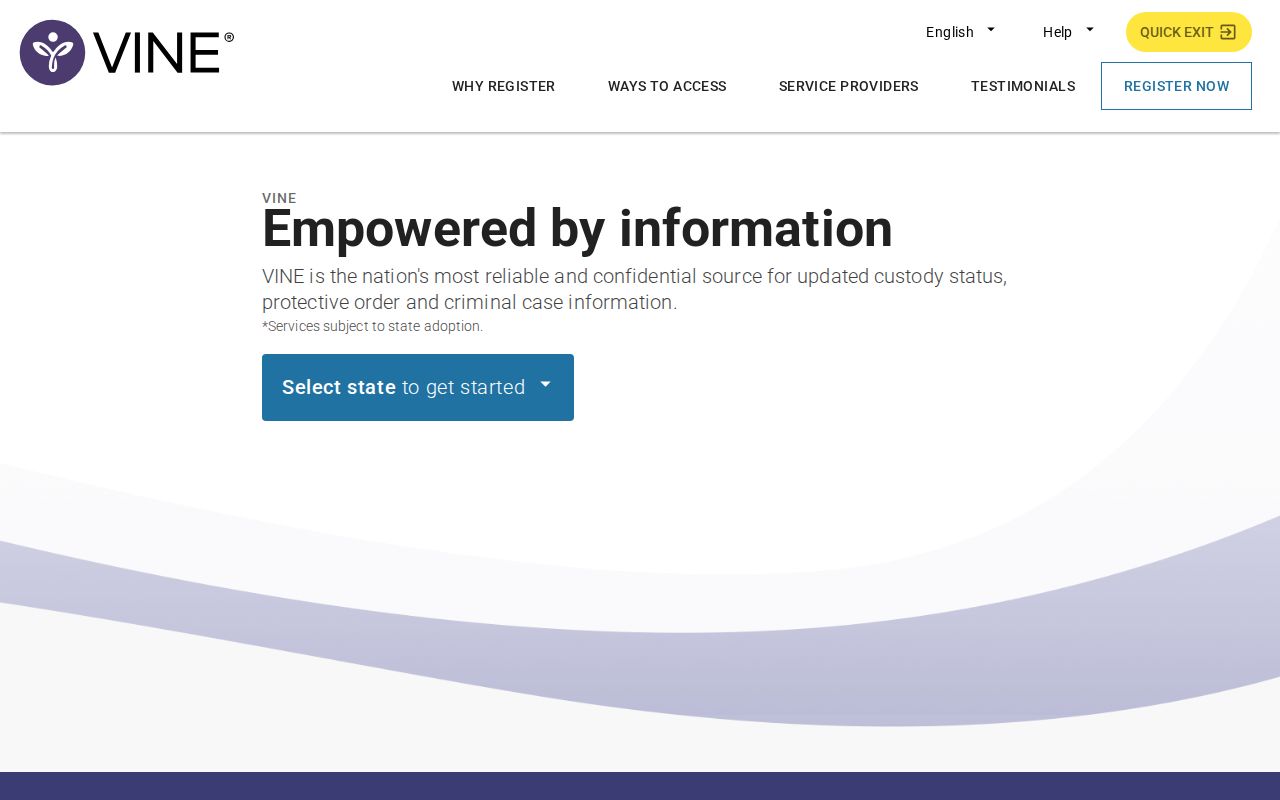
The screen confirms the search interface, not the custody or release status of any particular person.
Colorado County VINELink Release Fields
A matched record must be read as an agency report. VINE may show a status date, but that date is not automatically the exact time the jail door opened. It may be the feed’s event time or update time. When exact book-out time matters, request the source release event.
| Field | How to read it |
|---|---|
| Name or identifier | Use to distinguish the person from similar matches. |
| Custody agency | Shows which participating agency supplied the record. |
| Status | Repeat the exact phrase, such as in custody, released, out of custody, or transferred. |
| Location | May name the reporting facility; it is not a permanent address. |
| Status date | Dates the reported change or update, subject to the live field label. |
A released result can support a lead that county custody ended. Pair it with the Sheriff’s book-out record and the court disposition. A transfer result requires a receiving-system search. If TDCJ received the person, the current TDCJ locator may show state confinement. Federal and immigration transfers require their own locators.
Set a Colorado County Release Alert
Register from the correctly matched person record before the expected event. The current help flow uses “Get Notified,” then offers the available event types and delivery methods. Choices can include telephone, text, email, or app delivery, but the live record controls what is offered.
- Open the matched person record and select Get Notified.
- Choose the custody events and delivery method offered.
- Enter the telephone number or email destination accurately.
- Create and re-enter a four-digit PIN when prompted.
- Validate the destination and save the registration confirmation.
For an automated call, listen to the message and enter the PIN followed by the pound sign. Without acknowledgement, calls may repeat under the service rules. The PIN may also be required to change notification settings. Keep it private, and never publish another person’s contact details.
Registration is tied to the matched agency record. It should not be described as following a person automatically from Colorado County Jail into every state, federal, or immigration system. After a transfer, register through the receiving agency’s official notification service when one exists.
VINE Is Not Colorado County CodeRED
The county government Sheriff page prominently links “Victim Notification for Crime Victims.” The separate Sheriff site also promotes CodeRED. These services have different roles. VINE is the custody-change and notification path for a matched person record. CodeRED is a broad community emergency communications system and should not be used as an inmate-release service.
This local distinction prevents missed notices. Use the county Sheriff page to reach the victim-notification channel. Use the Sheriff’s separate public-safety communications for general alerts. A person seeking a prison or parole notice after TDCJ transfer should use TDCJ Victim Services registration, which can cover specified parole eligibility, Board decisions, movement, release, and discharge events.
Confirm Colorado County VINE Alerts
VINE data can lag behind the source agency. An alert is not a court disposition, warrant check, sentence calculation, or guarantee of safety. Contact law enforcement or the victim-services contact shown by the official service for immediate safety needs. For record verification, preserve the notification and ask the reporting agency for the underlying event.
For a Colorado County jail event, call the Jail Division and request the public book-out date, release or transfer category, and receiving authority if public. Obtain a written record when durable proof matters. For a state-prison event, use TDCJ inmate-information and records channels. The Colorado County released-inmate search joins the jail event with court and receiving-agency records.
VINELink does not replace the BOP inmate locator for sentenced federal prisoners or ICE ODLS for immigration custody. A federal pretrial detainee may be under USMS authority and absent from BOP. Each system describes its own custody only.
After a Colorado County Release Notice
Write down the time received, delivery channel, agency, person identifier, status words, and date shown. Then contact the source office. Ask whether the person left that agency’s custody, the public release type, and whether another authority received the person. An oral answer is a lead; a jail event report is the durable source.
Next read the criminal case. The Colorado County Clerk covers county-level criminal matters through its linked portal, while the District Clerk maintains district felony records. A judgment or dismissal can explain why custody ended, even when it does not show the exact physical release time. For parole, confirm actual TDCJ release rather than relying on eligibility or a favorable vote.
- Released
- Use only when the source reports release; check whether another hold changed the destination.
- Transferred
- Custody moved to another authority.
- Out of custody
- A system status that needs source confirmation and does not describe every other agency.
- No result
- An inconclusive search outcome, not proof of freedom or continued custody.
This source-by-source method keeps a fast notification from becoming an unsupported conclusion.
Colorado County Records After VINE
A VINE notice gains meaning when paired with the record that caused it. For Colorado County Jail, request the existing booking and release event by full name, date of birth if known, booking number if known, and an approximate date range. Ask for the book-in and book-out date and time, releasing authority, release type, public transfer destination, charges at release, and bond disposition. The Sheriff may redact fields protected by law.
The court record answers a different question. It may show a bond order, dismissal, judgment, sentence, jail credit, probation order, or revocation. The judgment can explain why custody ended, but it may not record the moment of physical departure. Search county-level cases through the Colorado County Clerk and district felonies through the District Clerk. Use the cause number from the booking or release record when available.
For a state transfer, the live TDCJ search covers current state prisoners. A person who later leaves TDCJ may disappear from that live search because it is not a former-prisoner archive. Request incarceration history and the actual release or discharge information through official TDCJ channels. Read parole eligibility, projected release, scheduled release, and actual release as separate stages.
Check Colorado County Alert Accuracy
Before relying on a saved result, verify that the screenshot or note contains the date checked, Texas selection, matched agency, and enough non-sensitive identifiers to explain the match. Minimize personal data. A blank search screen proves only what fields are offered, while a matched screen proves only what the agency feed reported at that moment.
Agency participation, interface controls, delivery methods, and status language can change. Revisit the official service instead of relying on an old screenshot. If a notice conflicts with the jail, ask each office for its event timestamp and source. The originating custody record controls the underlying event, and the receiving agency controls any later custody.
Keep notification registration active only as needed and follow the live service controls when changing or ending alerts. An old alert should not be treated as a current location report. A new booking, transfer, or supervision event can create a different record and may require another registration.
Time Colorado County VINE Checks
Search before an expected release so the correct record can be registered, then check again after any alert. Save the status date separately from the time the search was performed. A delayed feed can make those times differ. If the person vanishes from results, do not infer a release. Ask the reporting agency whether its record was removed, corrected, transferred, or closed.
For a near-term court event, monitor the filed docket as well as VINE. A bond order or dismissal may precede the physical book-out, while a new hold may prevent community release. For a TDCJ event, a favorable Board decision can precede release processing by a meaningful period. The agency’s actual event record resolves the sequence.